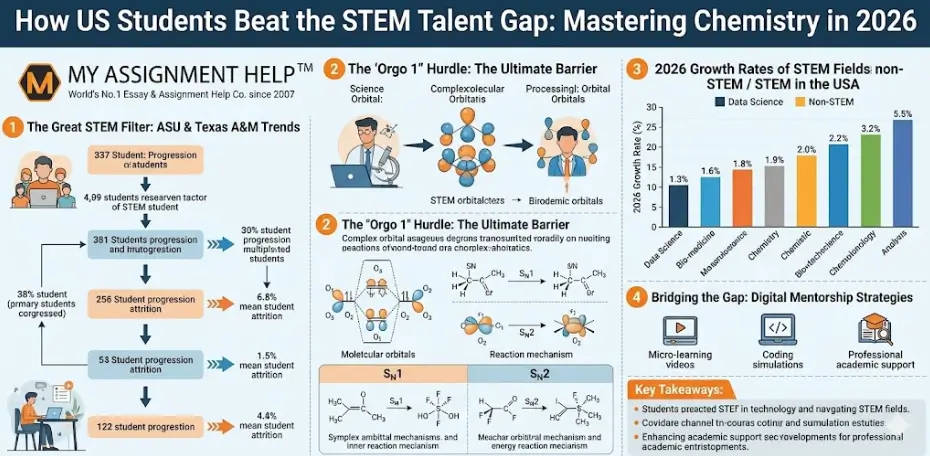

The American educational landscape is currently defined by a high-stakes race. While the Bureau of Labor Statistics (BLS) projects that mathematical and data science roles will grow by over 30% through 2033, the “talent gap” in physical sciences like chemistry remains a critical bottleneck. For students at large public institutions, the pressure to perform has never been higher.
The Great STEM Filter: Trends at ASU and Texas A&M
Recent data from 2025 and 2026 indicates a shift in how major US universities approach STEM retention. At high-enrollment schools like Arizona State University (ASU) and Texas A&M, educators are moving toward “adaptive learning” models to combat high attrition rates. Despite these efforts, the sheer volume of material in advanced science degrees remains a primary reason students transition out of STEM majors during their sophomore year.
In these competitive environments, students are no longer just studying harder; they are studying smarter. Many high-achieving undergraduates find that they must pay someone to do my assignment in order to find enough time to focus on professional academic support for their core laboratory research. This isn’t about avoiding work; it’s about tactical survival in a system where a single “C” grade in a foundational course can derail a Pre-Med or Engineering track.
The “Orgo 1” Hurdle: Why Chemistry is the Ultimate Barrier
If STEM is a pipeline, then Organic Chemistry (Orgo 1) is the valve that shuts it off for thousands of students. The transition from the quantitative, formulaic world of General Chemistry to the spatial, mechanistic reasoning of Organic Chemistry is famously brutal.
According to a 2026 study in Chemistry Education Research, the struggle isn’t just about memorizing reactions. It is the shift toward “chemical thinking”—understanding electron flow, resonance, and three-dimensional molecular geometry. For a student at UC Berkeley or Penn State, a single week of falling behind on stereochemistry can make the rest of the semester irrecoverable.
To bridge this gap, students are increasingly seeking hyper-specialized assistance. When faced with a 20-page lab report on electrophilic aromatic substitution, the decision to seek an expert to do my chemistry homework is often the only way to ensure the foundational concepts are mastered without sacrificing other credit-heavy courses like Physics or Calculus.
Data Spotlight: The 2026 Lab Workforce Paradox
While “Tech” gets the headlines, the “Bench Science” workforce—chemists, biochemists, and biophysicists—is projected to grow at a steady 5-6%. However, the complexity of these roles is increasing.
- Automation at the Bench: 2026 laboratory roles now require proficiency in AI-driven molecular modeling.
- The GPA Floor: Most top-tier US graduate programs and medical schools have maintained a strict 3.5+ GPA floor for STEM applicants.
- Retention Crisis: Nearly 50% of students who intended to major in STEM change their minds by graduation, citing “course difficulty” as the leading factor.
Bridging the Gap: The Rise of Digital Mentorship
Modern students are overcoming these hurdles through a “Hybrid Learning” strategy:
- AI-Collaborative Coding: Using Python to simulate chemical reactions before entering the physical lab.
- Peer-Led Team Learning (PLTL): High-enrollment US universities are increasingly adopting flipped-classroom models where students teach each other.
- Specialized Academic Support: Using professional platforms to break down complex mechanisms like $S_N1$ and $S_N2$ reactions into digestible, visual steps.
Key Takeaways for US Students
- Localized Pressure: Large public universities are seeing record enrollment but struggle with retaining students in “weed-out” courses.
- The Chemistry Wall: The jump to Organic Chemistry remains the most significant academic challenge for STEM majors.
- Strategic Management: Successful students utilize professional support to maintain their GPAs while focusing on high-level conceptual mastery.
- Future Readiness: Mastering 2026 STEM standards requires a mix of theoretical knowledge and digital literacy.
See also: Crypto Infrastructure and Financial Ecosystems
Frequently Asked Questions (FAQ)
Q1: Is Organic Chemistry really the hardest course in a STEM degree?
For most Pre-Med and Biology students, yes. It requires a different type of cognitive processing (spatial reasoning) compared to the math-heavy General Chemistry.
Q2: How are US universities like ASU helping STEM students?
Many are implementing adaptive learning software and “early intervention” alerts that notify advisors when a student’s quiz scores in Orgo 1 or Calc II dip below a certain threshold.
Q3: How do academic support services help with “Helpful Content” standards?
By providing subject-matter expertise that goes beyond simple answers, these services act as digital mentors, helping students understand the underlying mechanisms of their coursework.
Author Biography
Mark Harrison is a Senior Content Strategist at MyAssignmentHelp. With over a decade of experience analyzing educational metrics at major US public universities, Mark specializes in creating data-driven resources for STEM students. His expertise lies in bridging the gap between rigorous academic requirements and modern student success strategies.
References
- National Science Foundation (2026). The State of U.S. Science and Engineering.
- Bureau of Labor Statistics (2025). Occupational Outlook for STEM Professionals.
- Journal of Chemical Education (2026). “Flipped Classrooms and Student Retention in Orgo 1.”
- ASU/Texas A&M Internal Educational Trend Reports (2025-2026).